- Updated 26 November 2026
- 34 states & UTs
NREGA Job Card List 2026-2027
Open the official employment register for your own gram panchayat, read what every column and colour on it means, and see what changed when VB-G RAM G replaced MGNREGA on 1 July 2026.
- Free, no login
- No Aadhaar asked
- Government sources, dated
Find your gram panchayat
Pick state, district, block and panchayat. You get the exact names and official LGD codes to select on the government reports portal.
Names and codes: Local Government Directory (LGD), Ministry of Panchayati Raj, Government of India. LGD data as of . Covers 34 states and UTs, 762 districts, 7,248 rural blocks, 2,58,641 gram panchayats and 13,397 village councils.
JobCardSetu is an independent guide, not a government website. Nothing you select is stored or sent anywhere; the lists load from this website.
Quick answer
The NREGA job card list is the public register of every household holding a job card in a gram panchayat. Since 1 July 2026 it sits on the official VB-G RAM G portal. It is free, needs no login, and shows each household’s card number, head of household and card status.
- Still valid? Old MGNREGA job cards stay valid where e-KYC is complete, until the new Gramin Rozgar Guarantee Card is issued. No reapplication.
- e-KYC pending? The Ministry says a pending e-KYC does not stop you demanding or getting work.
- Guarantee: 125 days of wage employment per rural household each financial year, up from 100.
- To search: state, district, block, gram panchayat and financial year. No Aadhaar, no job card number.
- State by state: all 34 states and UTs are listed on our NREGA job card list state wise page.
- Who we are: an independent guide, not a government website. Every rule below is taken from a dated official source.
NREGA job card list at a glance
| Question | Answer | Official basis |
|---|---|---|
| What is it? | The Job Card / Employment Register of a gram panchayat: one row per registered household | VB-G RAM G portal reports |
| Scheme now | Viksit Bharat – Guarantee for Rozgar and Ajeevika Mission (Gramin), VB-G RAM G | PIB FAQ, 11 May 2026 |
| Old scheme | Mahatma Gandhi NREGA, repealed with effect from 1 July 2026 | PIB FAQ, Q3 |
| Where to check | vbgramg.dord.gov.in, with reports opening on vbgramgrep.dord.gov.in | Ministry of Rural Development |
| Login or fee | Neither. The reports are public | Portal is open to the public |
| Details you need | State, district, block, gram panchayat, financial year | Report path on the portal |
| Days guaranteed | 125 per rural household per financial year | PIB FAQ, Q5 and Q11 |
| Work must be given within | 15 days of the date you apply | PIB FAQ, Q16 |
| Your old job card | Valid where e-KYC is complete, until a Gramin Rozgar Guarantee Card is issued | PIB FAQ, Q12; PIB release, 30 June 2026 |
| New card name | Gramin Rozgar Guarantee Card | PIB FAQ, Q14 |
| Wages paid | Weekly, and never later than a fortnight after the muster roll closes, by DBT to a bank or post office account | PIB FAQ, Q20 and Q21 |
| Wage range now | Rs 300 to Rs 450 a day, depending on the state | PIB factsheet, 24 October 2026 |
| Coverage | All rural areas: 34 states and union territories with rural blocks | PIB FAQ, Q2 and Q4; portal state list |
| Ministry | Department of Rural Development, Ministry of Rural Development, Government of India | PIB FAQ reference |
What the job card list really is
People search for “the job card list” as if it were a single national file. It is not. Every gram panchayat keeps its own register of the households that have been issued a job card, and the official portal publishes each of those registers as a report. When you open the list, you are looking at one panchayat, for one financial year, and nothing else.
Three things follow from that, and they explain most of the trouble people run into:
- It is a household list, not a person list. Each row is a family, recorded under the name of the head of the household. A son, daughter or wife on the same card will not have a row of their own.
- It is local. If you choose a neighbouring panchayat, or the right panchayat under the wrong block, your family will simply not be there.
- It is yearly. The register is organised by financial year, which in India runs from April to March. The current one is 2026-2027.
The register is maintained by the gram panchayat and the block office, and published by the Ministry of Rural Development. JobCardSetu does not hold, change or copy it. What we do is explain the route to it, what every mark on it means, and what to do when the list does not show what you expected.
Looking for your own state? The state wise job card list carries the full 34-row table, the exact click path with every label, PDF saving on any phone, and a troubleshooting workflow. This page is the starting point; that one is the complete manual.
NREGA, MGNREGA or VB-G RAM G: which name is right?
All three names point to India’s rural employment guarantee, at different stages of its life. That is why searches for “NREGA job card list”, “MGNREGA job card list” and “VB-G RAM G job card list” all lead to the same register.
| Name | What it refers to | Status today |
|---|---|---|
| NREGA | National Rural Employment Guarantee Act, 2005, the original law and the name most people still use | Historical name; still the common search term |
| MGNREGA | The same Act after it was renamed after Mahatma Gandhi | Repealed with effect from 1 July 2026 |
| VB-G RAM G | Viksit Bharat – Guarantee for Rozgar and Ajeevika Mission (Gramin) Act, 2025 | In force in all rural areas from 1 July 2026 |
| Job card | The household card issued under MGNREGA | Valid where e-KYC is complete, until replaced |
| Gramin Rozgar Guarantee Card | The household card under the new Act | Being issued; the PIB factsheet counts 15.17 crore issued as of 24 September 2026 |
The switch happened everywhere on the same day, not state by state. The PIB FAQ of 11 May 2026 says so directly, and a PIB release of 28 July 2026 confirms that all states and union territories have notified their own VB-G RAM G schemes and started implementing them.
Is my job card still valid after 1 July 2026?
This is the question behind most searches right now, so here it is without hedging. Find the row that matches your situation:
| Your situation | What the official position is | What to do |
|---|---|---|
| You have an MGNREGA job card and your e-KYC is complete | The card remains valid until a new Gramin Rozgar Guarantee Card is issued to you | Nothing. Keep using it, and apply for work as before |
| You have a card but e-KYC is still pending | The Ministry stated on 30 August 2026 that every registered worker was migrated to VB-G RAM G whatever their e-KYC status, and that a pending e-KYC does not prevent a worker from demanding or receiving work | Demand work anyway. Complete e-KYC at the panchayat when you can, because it keeps the card valid for the long term |
| Your household has no card | Any adult member can apply to the gram panchayat with the names, ages and address of the household for a Gramin Rozgar Guarantee Card | Apply in writing and keep a dated copy |
| Your name shows an asterisk on the list | The asterisk marks a card removed from the register | Ask the gram panchayat, in writing, for the reason and the route to restore it |
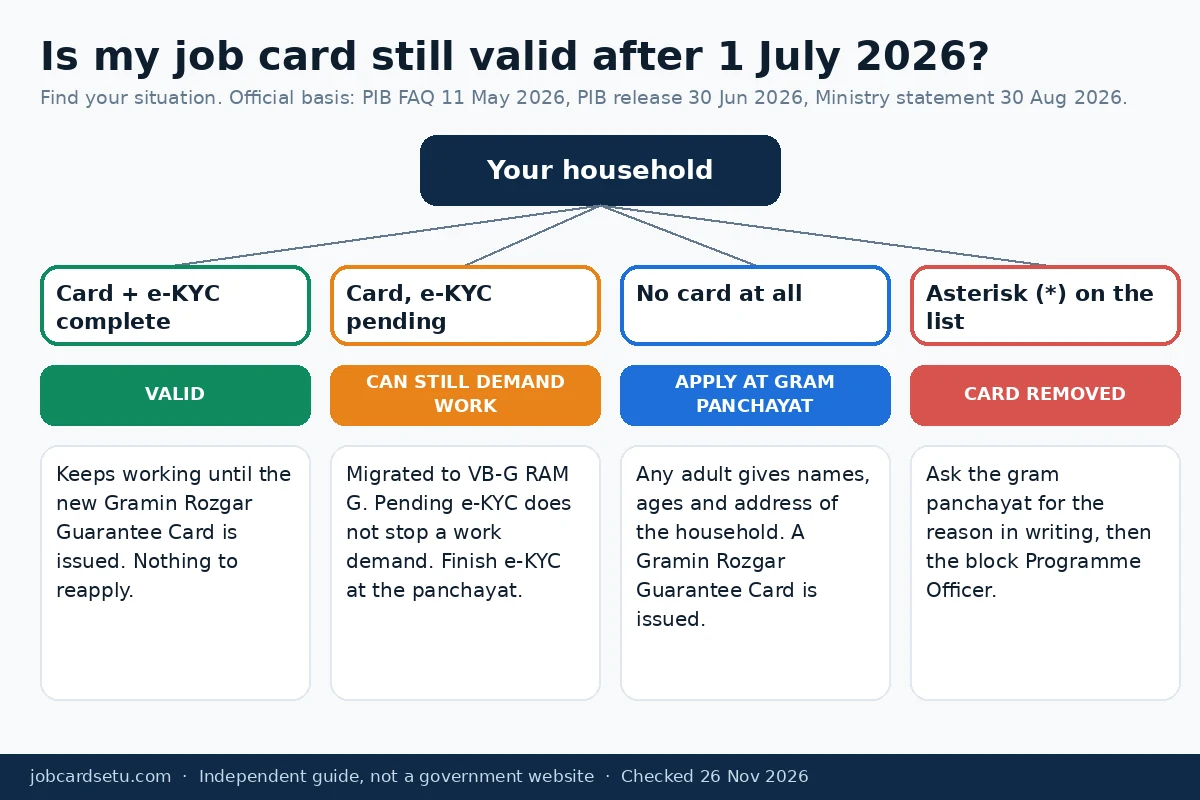
e-KYC is described by the Ministry as a database-authentication step carried out by state governments, not as a condition for your right to ask for work. If anyone refuses your demand for work only because e-KYC is pending, that refusal goes against the Ministry’s stated position. Ask for the refusal in writing and take it to the Programme Officer at the block.
How to check the NREGA job card list in five steps
The route is the same for every state. It takes about a minute on a normal mobile connection, and you can follow it with nothing more than the name of your panchayat. Before you begin, make sure you know the name of your block. In some states it is called a mandal, a taluka or a panchayat samiti, and it is the step where most searches go wrong.
- Open the official portal
Go to vbgramg.dord.gov.in. The address must end in
gov.in. The public reports never ask for money, an OTP, Aadhaar or a password. - Choose Analytics & Reports, then State Report
This is the public side of the portal. The report pages open on
vbgramgrep.dord.gov.in, which belongs to the same ministry. - Narrow down to your gram panchayat
Pick your state, then district, block and gram panchayat, and the financial year 2026-2027.
- Open R1, then Job card/Employment Register
The panchayat page is divided into sections R1 to R6. The household list sits in R1, the registration section.
- Find the head of your household
Search the page for the head of household’s name, then tap the job card number beside it to open the full family record where the portal provides it.
Need the long version, with the panchayat page explained section by section, PDF saving on Android, iPhone and computer, and what each error message on the portal means? It is all on the state wise job card list guide.
What each entry on the list tells you
A row on the register is short, but every column has a job. Reading it properly tells you whether anything needs fixing before you next ask for work.
| On the list | What it tells you | Why it matters |
|---|---|---|
| Job card number | A stacked code for state, district, block, panchayat and your household serial | You need it for payment and muster roll checks |
| Head of household | The name the card is registered under | This, not your own name, is what you search for |
| Row colour | Whether a photo is on record and whether the household worked this year | Tells you if the panchayat needs to add a photograph |
| Asterisk beside the name | The card has been removed from the register | The one mark that needs action straight away |
| Financial year | The year you selected | A household may appear in one year and not another |
The opening letters of a job card number belong to the state, so you can tell at a glance if a number someone has given you is from another state’s register. The digits after the slash identify your family within the panchayat.
The colour codes and the asterisk
| Mark | Photo on record | Worked this year | What to do |
|---|---|---|---|
| Green | Yes | Yes | Nothing; the record is complete |
| Grey | Yes | No | Nothing is wrong. Ask for work when you need it |
| Sunflower | No | Yes | Give the panchayat a photograph for the card |
| Red | No | No | Give the panchayat a photograph; the card is not cancelled |
| Asterisk (*) | — | — | Card removed. Ask for the written reason at once |
Which problem do you have?
Most visits to this site start with a specific worry. Pick yours:
| Your problem | Short answer | Where to go next |
|---|---|---|
| My name is not on the list | Search the head of household, check the block, then the previous year | The 9-check workflow on the state wise guide |
| I see a star next to our name | The card was removed; the panchayat holds the reason | Ask the gram panchayat in writing |
| Our row is red or yellow | A photograph is missing; the card still works | Take a photo to the panchayat |
| I want the list as a PDF | Use the browser’s Print, then Save as PDF | PDF steps for phone and computer |
| Someone says e-KYC is compulsory before work | Pending e-KYC does not stop a work demand, per the Ministry, 30 August 2026 | Ask for the refusal in writing; Programme Officer at the block |
| We have no card at all | Apply at the gram panchayat for a Gramin Rozgar Guarantee Card | Take names, ages and address of adult members |
| The portal shows an error | Usually traffic or an expired session, not a lost record | Error messages decoded |
Your rights once your household is on the list
Being on the register is the doorway to a legal guarantee. These are the entitlements the PIB FAQ of 11 May 2026 sets out under the new Act, with the question number so you can check each one yourself in the official FAQ document.
| Right | What the official FAQ says | FAQ no. |
|---|---|---|
| Days of work | 125 days of wage employment per eligible rural household per financial year | 5, 11 |
| How to ask | Orally, in writing on the same Form 6 as before, or through digital platforms, to the gram panchayat, Programme Officer or an authorised person | 15 |
| Time limit | Work within 15 days of the date of application | 16 |
| If no work comes | Unemployment allowance from the state: at least a quarter of the notified wage for the first 30 days in the year, at least half after that | 17, 18 |
| Wage rate | Enhanced rates under Section 10 of the Act; until they are notified, the existing rates continue | 19 |
| Payment speed | Weekly, and no later than a fortnight after the muster roll closes | 20 |
| Late wages | Delay compensation at 0.05% of unpaid wages per day once 15 days have passed after muster roll closure | 22 |
| Distance | Work within 5 km of the village where possible; beyond that, within the block, an extra 10% of the wage | 26 |
| Worksite | Safe drinking water, shade for children and rest, and a first aid box | 24 |
| Attendance | Face authentication, with an exception route for poor network, technical or device problems | 23 |
| No contractors | Contractors cannot be engaged for works under the Act | 30 |
Keep proof of every demand for work. A dated receipt, or a photo of your stamped written application, is what starts the 15-day clock and backs any claim for unemployment allowance.
There is one more point worth knowing about the guarantee itself. A PIB release of 4 August 2026 notes that under Section 5(4) of the Act, a state government may provide days of work beyond the guaranteed 125 from its own resources. Whether your state does so is a state decision.
The programme in numbers
These national figures come from the Press Information Bureau factsheet published on 24 October 2026, and describe the position as of 24 September 2026. We quote them as published and do not estimate per-state figures.
| Measure | Figure |
|---|---|
| Active workers, 2026-27 | 10.88 crore |
| Gramin Rozgar Guarantee Cards issued | 15.17 crore |
| Person-days generated | More than 31.69 crore |
| Women’s participation | 61.65 percent |
| Workers given employment on demand | Over 2.81 crore, from about 2.23 crore households |
| Gram panchayats executing works | Nearly 2.31 lakh |
| Wage rate range | Rs 300 to Rs 450 per day |
Source: PIB factsheet, Viksit Bharat-G RAM G, 24 October 2026.
How to tell the official portal from a copy
Because the list is in demand, many sites imitate the official look. A few checks keep you safe:
- Look at the address. The official portal ends in
dord.gov.in. A site ending in .com, .in or .app is not the government, whatever its logo looks like. That includes this one. - Nobody should charge you. Viewing the register is free. Any page, agent or app asking for a fee to “show” your card is not official.
- The public list needs no Aadhaar. Do not type Aadhaar, bank or OTP details into any site just to see a list.
- A saved PDF is a copy. It is useful for your records, but for anything formal, ask the gram panchayat for a copy of the card itself.
Frequently asked questions
Is the NREGA job card list free to check?
Yes. The register is a public report on the official portal. It costs nothing, needs no login and no registration, and no website or agent should charge you to see it.
Has MGNREGA ended?
Yes. Mahatma Gandhi NREGA was repealed with effect from 1 July 2026 and replaced across all rural areas, on the same day, by the VB-G RAM G Act, 2025.
Is my old MGNREGA job card still valid?
Yes, if your e-KYC is complete. It stays valid until a new Gramin Rozgar Guarantee Card is issued to you, and you do not need to reapply.
Can I be refused work because my e-KYC is pending?
According to the Ministry of Rural Development’s statement of 30 August 2026, a pending e-KYC does not prevent a worker from demanding or receiving work, and an exception mechanism exists for such workers.
How many days of work are guaranteed now?
125 days of wage employment per rural household in each financial year, raised from 100 days under the old Act.
Can I search the list by my name or Aadhaar number across India?
No. There is no national name or Aadhaar search for the public register. You open your own gram panchayat’s register and search the head of household’s name on that page.
Why can I not find my name?
The list shows one row per household under the head of household’s name. If that name is also missing, the usual causes are the wrong block, the wrong financial year, a different spelling, or a removed card. Our state wise guide has a full check list.
What does a star next to a name mean?
An asterisk marks a job card that has been removed from the register. Ask the gram panchayat for the reason in writing, because the office holds the record of why it was removed.
Do I need to log in to the VB-G RAM G portal?
No. The public reports, including the job card register, open without any account. You never need a password, OTP or Aadhaar to view the list.
Where are the records from years before 2026-27?
Records made before 1 July 2026 were made under MGNREGA. If the year menu on the report page offers an earlier year, select it; if not, the gram panchayat keeps the registers and can show your household’s history.
How do I get a new card if my household has none?
Any adult member applies to the gram panchayat with the names, ages and address of the household. The panchayat issues a Gramin Rozgar Guarantee Card.
Is JobCardSetu a government website?
No. JobCardSetu is an independent information site with no connection to any ministry or panchayat. Every official action happens on the government portal or at your gram panchayat.
Sources and how this page is checked
Press Information Bureau, Viksit Bharat-G RAM G Act, 2025 Frequently Asked Questions, 11 May 2026. Basis for the repeal date, the 125-day guarantee, card validity, registration, the 15-day limit, unemployment allowance, wages, delay compensation, distance, worksite facilities and attendance. Read the PIB FAQ (PDF).
Press Information Bureau release, 30 June 2026. Confirms that existing e-KYC verified job cards remain valid until new Gramin Rozgar Guarantee Cards are issued. Read the release.
Press Information Bureau release, 28 July 2026. All states and UTs have notified their VB-G RAM G schemes. Read the release.
Press Information Bureau release, 4 August 2026. Section 5(4): states may add days beyond the guarantee from their own resources. Read the release.
Ministry of Rural Development statement, 30 August 2026, as reported by The Hindu on the same day. Basis for the e-KYC position: all registered workers migrated, and pending e-KYC does not prevent a work demand.
Press Information Bureau factsheet, 24 October 2026. National figures as of 24 September 2026. Read the factsheet.
Ministry of Rural Development, VB-G RAM G portal. The register and its report path. vbgramg.dord.gov.in.
Last verified: 26 November 2026. The diagrams and infographics on this page are our own illustrations, not screenshots of the portal. JobCardSetu is an independent information site and is not a government website. Read our editorial policy, the full list of official sources and our disclaimer.
Job card list by state
Every state guide carries that state's own click path, its wage rate with the effective date, and its job card number format.
More state guides being written29 to come
- Arunachal Pradesh
- Bihar
- Chhattisgarh
- Goa
- Gujarat
- Haryana
- Himachal Pradesh
- Jammu and Kashmir
- Jharkhand
- Karnataka
- Kerala
- Ladakh
- Lakshadweep
- Madhya Pradesh
- Manipur
- Meghalaya
- Mizoram
- Nagaland
- Odisha
- Puducherry
- Rajasthan
- Sikkim
- Tamil Nadu
- Tripura
- Uttar Pradesh
- Uttarakhand
- West Bengal
- Andaman and Nicobar
- Dadra and Nagar Haveli and Daman and Diu
Until a state guide is published, use the finder above. It opens the official portal for any state straight away.
No state matches that name.
Recently updated
Kept current as the official portals and the rules change.
Where every figure on this site comes from
The rules on this page come from the Press Information Bureau release of 11 May 2026 and the factsheet of 24 October 2026, and from the Ministry of Rural Development portal.
Wage rates and administrative figures change. Every one carries the date it was read, so you can judge for yourself how current it is. This page was last checked on 26 November 2026.
When something is wrong we fix it and say what changed, rather than quietly editing the page. The portal migration of July 2026 is the current example.
JobCardSetu is an independent information site. It is not a government website and has no connection to the Ministry of Rural Development. We never ask for a payment, an Aadhaar number or a login, and every official action happens on the government portal itself.